Zakat Calculator
Enter the value of your assets and liabilities in your local currency. Click the button below to determine your Zakat.
Do you want to avoid the manual process of calculating Zakat and do it with just one click?
Don’t worry—you’ve come to the right place.
We have handled all the complex calculations and broken them down into simple, easy-to-follow steps.
Zakat Calculator Online 2026
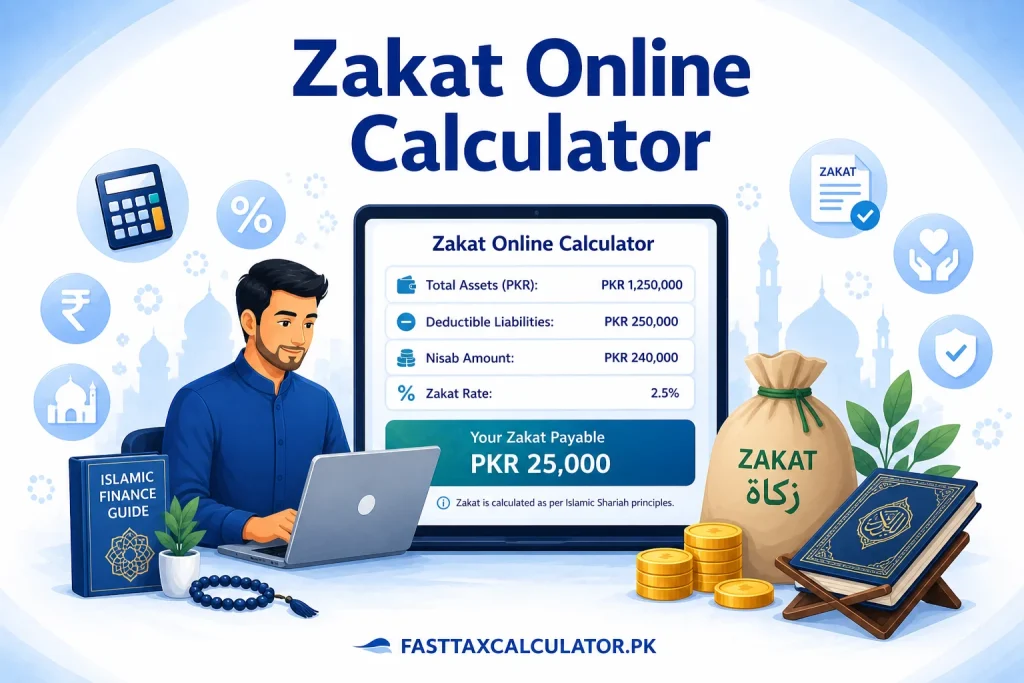
Simply enter your assets (gold, silver, cash, savings, and business assets) and liabilities (debts, etc.) into the calculator. It will automatically determine your net assets; if they exceed the required threshold, it will show you the exact amount of Zakat you need to pay.
What is Zakat?
Zakat is one of the five pillars of Islam and is next in importance to prayer (Salat). It is mandatory for every adult Muslim who possesses a certain minimum amount of wealth, known as Nisab (discussed below), to pay a specific charitable amount.
…and those in whose wealth there is a recognised right, for the needy and deprived. Qur’an 70:24-5

Zakat Vs Fitrana
Zakat can be paid in cash or kind at any time of the year. In contrast, Sadaqat al-Fitr (often called Fitrana) is a mandatory charitable donation typically given in the form of staple food (or its cash equivalent) to the needy during Ramadan before the Eid al-Fitr prayer. It is paid on behalf of oneself and one’s dependents.
What is Nisab
Nisab is the minimum amount of net wealth a Muslim must possess for one full lunar year to be obligated to pay Zakat. This threshold is standardized based on one of two measures: the value of 87.48 grams of gold (approximately 3 troy ounces or 7.5 tolas) or the value of 612.36 grams of silver (21 ounces). Since the market value of gold and silver constantly fluctuates, the cash equivalent of the Nisab threshold changes. If your net wealth meets or exceeds this threshold, you are required to pay Zakat at a rate of 2.5% of your total net wealth. You can check the current prices here.
And be steadfast in prayer and regular in charity: And whatever good you send forth for your souls before you, you shall find it with Allah.Qur’an 2:110
Formula For Zakat Calculation
Zakat is calculated as 2.5% of your eligible wealth after meeting the minimum threshold (Nisab) and holding it for one lunar year.
Zakat=(Total Assets−Liabilities)×2.5%
Also check your payable tax using our online tax calculator for Pakistan.
Is zakat on income or savings?
Zakat is not calculated based on income or savings alone; rather, it is based on your total net wealth if it exceeds the Zakat threshold, commonly known as Nisab.
If your wealth exceeds the Nisab, you are required to pay 2.5% of that wealth as Zakat.
Deductions From Zakat
You can deduct certain debts and liabilities when calculating your Zakat. The details of what can be deducted are provided below:
- Any debt to be paid within a year.
- Installments for the next 12 months of any long-term debt.
- Amount of debt that has already been repaid.
- General living expenses and bills due immediately.
- For mortgages and student loans, only the amount that is currently overdue or due imminently.
When should I pay zakat and how often?
Zakat is typically paid once every lunar year.
The date for payment varies for everyone. It is based on the day your wealth first exceeded the Nisab and was held for a full lunar year(hawl).
8 Categories of People Who Can Receive Zakat (According to the Qur’an)
The Qur’an clearly defines who is eligible to receive Zakat in Surah At-Tawbah (9:60). These are eight specific categories, ensuring Zakat is distributed fairly and reaches those who truly need it.
1. The Poor (Al-Fuqara)
People who have little to no income and cannot meet their basic daily needs like food, clothing, and shelter.
2. The Needy (Al-Masakeen)
Those who have some income but it is not enough to cover their essential expenses.
3. Zakat Administrators (Amil)
Individuals appointed to collect, manage, and distribute Zakat funds. They can receive a portion as compensation for their work.
4. Those Whose Hearts Are to Be Reconciled (Mu’allafatul Quloob)
People who are close to Islam or new to the faith and need financial support to strengthen their connection and stability.
5. Those in Bondage (Freeing Slaves)
Historically, this referred to freeing slaves. In today’s context, it can include helping people trapped in unjust conditions or severe hardship.
6. Those in Debt (Al-Gharimeen)
People who are overwhelmed by debt and unable to repay it, especially if the debt was taken for basic needs or lawful reasons.
7. In the Cause of Allah (Fi Sabilillah)
This includes efforts that serve the community and promote good causes, such as education, welfare, and religious initiatives.
8. The Wayfarer (Ibn-us-Sabil)
Travelers who are stranded or cut off from their financial resources, even if they are normally well-off back home.
Who Cannot Receive Zakat?
Generally, Zakat cannot be given to:
- People whose wealth exceeds the Nisab (the wealthy).
- Non-Muslims.
- Immediate dependents (parents, children, and spouse), as one is already obligated to support them.
- Those who are healthy and able to work but choose not to.
The rule of ineligibility applies to immediate dependents but not to other close relatives. It is recommended to give Zakat to needy close relatives when they are eligible recipients.
Benefits of Using an Online Zakat Calculator
Accuracy
An online Zakat calculator helps you avoid manual errors by automatically applying the correct formula. It ensures your assets and liabilities are calculated precisely, giving you a reliable Zakat amount.
Time-Saving
Instead of doing lengthy calculations yourself, a calculator gives instant results within seconds. This makes it especially useful during busy times like Ramadan when many people are calculating Zakat.
Easy for Beginners
Even if you have no prior knowledge of Zakat calculations, an online tool simplifies the process. You just enter your values, and it guides you step-by-step to get the final amount.