Capital Gain Tax On Property Calculator – Free Online
Capital Gain Tax on Properties Calculator Pakistan 2026 27
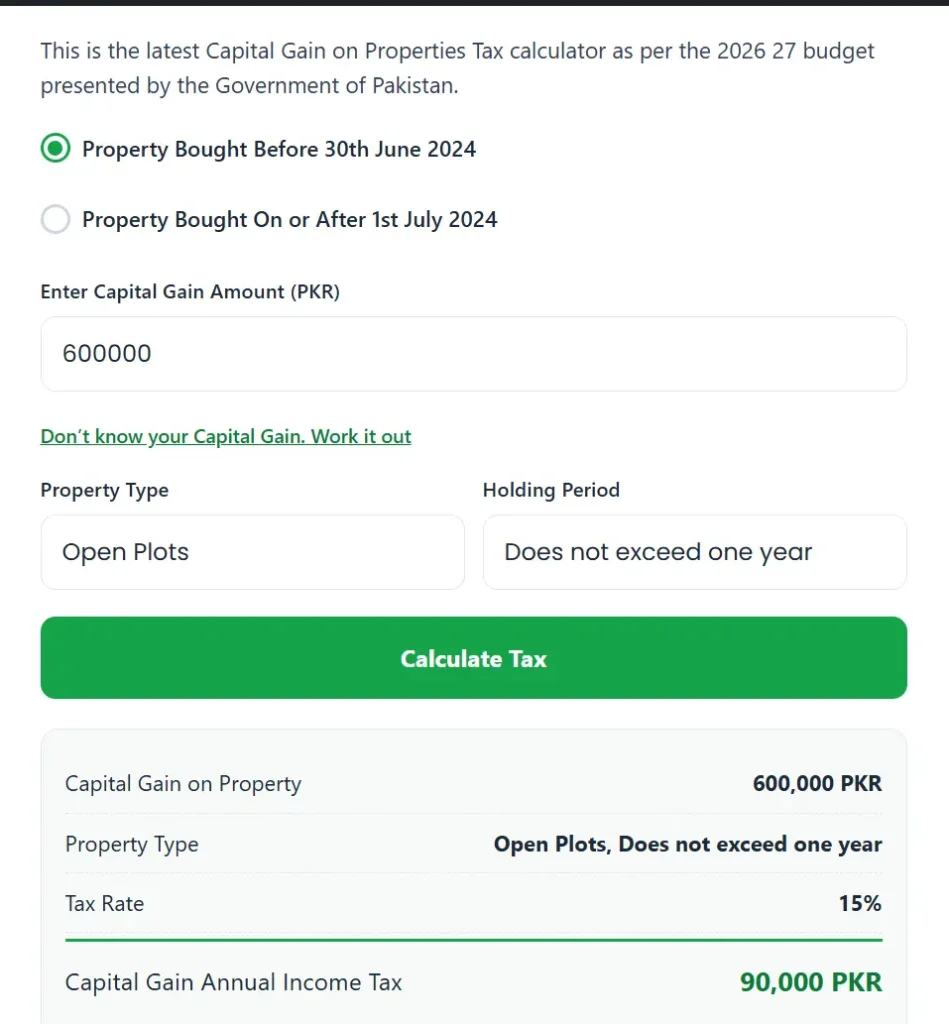
This is the latest Capital Gain tax on Properties calculator as per the 2026 27 budget presented by the Government of Pakistan.
Buying an open plot, constructing a building, or parking savings in real estate after retirement is one of the most popular financial moves in Pakistan. Yet most people have no idea how much tax they owe when they finally sell or transfer that property.
Don't worry, in this article we'll walk you through the exact taxation process: what Capital Gain Tax (CGT) is, how it's calculated, and the formula the Federal Board of Revenue (FBR) uses to arrive at the final figure.
Table of Contents
- What is Capital Gain Tax?
- How Is Capital Gain Tax Calculated?
- CGT Rates in Pakistan
- Exemptions
- How to Use the Calculator
- Benefits of Using Our Calculator
- Common Mistakes & How to Avoid Them
- Conclusion
- FAQs
What Is Capital Gain Tax?

Capital Gain Tax is the tax the FBR charges on the profit made when someone sells an immovable property, whether that's a file, an open plot, or a constructed residential or commercial building.
The most important point to understand is that CGT is charged on the profit, not on the full sale amount. Many people confuse the two and assume they'll be taxed on the entire selling or purchase price, which isn't the case.
CGT on property is governed by Section 37 of the Income Tax Ordinance, 2001, and is revised periodically through the annual Finance Act.
Other Related Calculators
How Is Capital Gain Tax Calculated?
There are two ways to work it out. The easiest is to use our free Capital Gain Tax Calculator, built by taxation experts to help everyone estimate their liability in seconds.
The alternative is to calculate it manually. To do this, you first need to determine the amount on which the tax will actually apply. Here's how:
Formula
Capital Gain (Taxable Amount) = Sale Price − (Purchase Cost + Deductible Expenses)
The capital gain is the figure the tax rate is applied to. The sale price is what you sold the property for, the purchase cost is what you originally paid for it, and deductible expenses include costs like agent commission, legal or transfer charges, and documented improvement or maintenance costs.
Once you've worked out the taxable gain, the applicable rate depends on when the property was purchased, before or after June 30, 2024, as explained below.
CGT Rates in Pakistan
Taxation System Before June 30, 2024 (Old Regime)
Under the old regime, the tax rate depends on how long you've held the property: the longer you hold it, the lower the rate you pay. Full exemption kicks in once the holding period crosses a set threshold, which varies by property type:
Holding Period (Year) | Open Plots | Constructed Property | Flats |
|---|---|---|---|
≤ 1 | 15% | 15% | 15% |
1 – 2 | 12.50% | 10% | 7.50% |
2 – 3 | 10% | 7.50% | 0 |
3 – 4 | 7.50% | 5% | – |
4 – 5 | 5% | 0 | – |
5 – 6 | 2.50% | – | – |
6+ | 0% | – | – |
Within these windows, the rate tapers down year over year, starting higher in the first year of ownership and gradually falling until the exemption threshold is reached.
Taxation After June 30, 2024 (New Regime)
The new regime removes the holding period benefit entirely and instead bases the rate mainly on your status on the Active Taxpayer List (ATL):
- On the ATL (Filer): A flat 15% tax applies, regardless of the nature of the transaction or how long the property was held.
- Not on the ATL (Non Filer): The rate depends on the nature of the seller:
- Individuals & Associations of Persons (AOPs): 15% to 40% (slab based)
- Restricted AOPs: up to 45%
- Banking companies and small companies: 40%
- All other companies: a flat 29%
Beyond CGT itself, property transactions in Pakistan also attract advance tax on sale or transfer (Section 236C) and on purchase (Section 236K), typically ranging from 1.5% to 5.5% of the property's value depending on the amount and the filer status of both parties, along with Capital Value Tax (CVT) and provincial stamp duty at the time of registration. These are separate from CGT but worth factoring into your total transaction cost.
Exemptions
Certain properties are exempt from Capital Gain Tax altogether:
- Property used by serving members of the armed forces
- Property owned by an employee of the federal or provincial government who died while in service
- Buildings used by the local, federal, or provincial government
- Buildings used strictly for taxable business purposes
How to Use the Capital Gain Tax Calculator: Step by Step
Here is the step-by-step process to use this calculator:
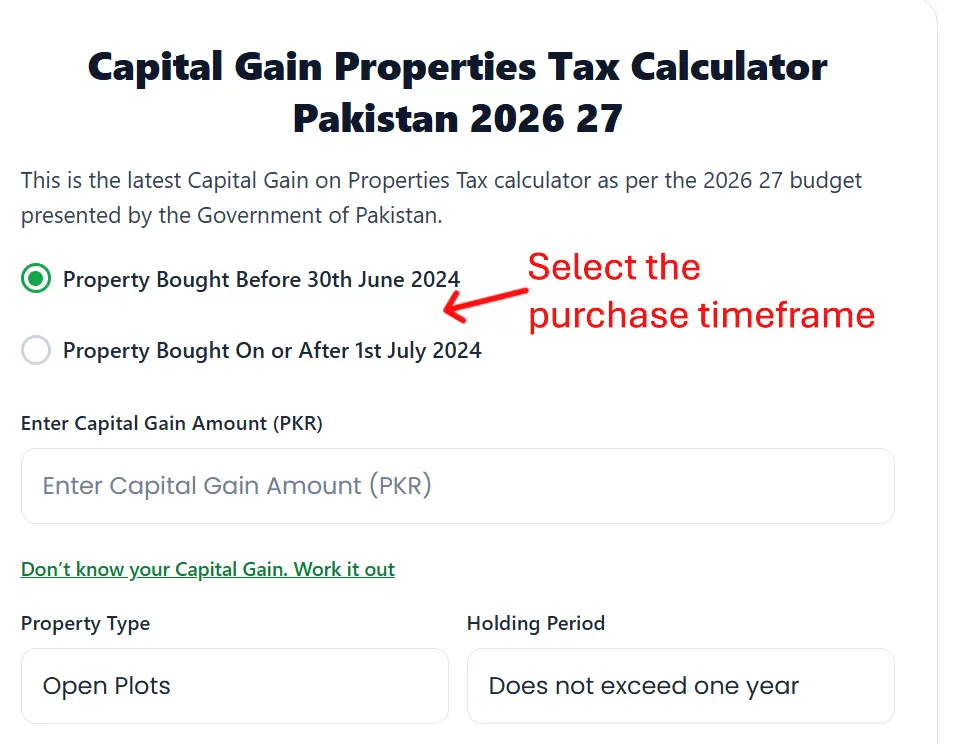
Select the purchase timeframe: At the top of the calculator, choose between property bought before June 30, 2024, or property bought on or after July 1, 2024. This toggles the correct FBR tax rules for your specific property regime.
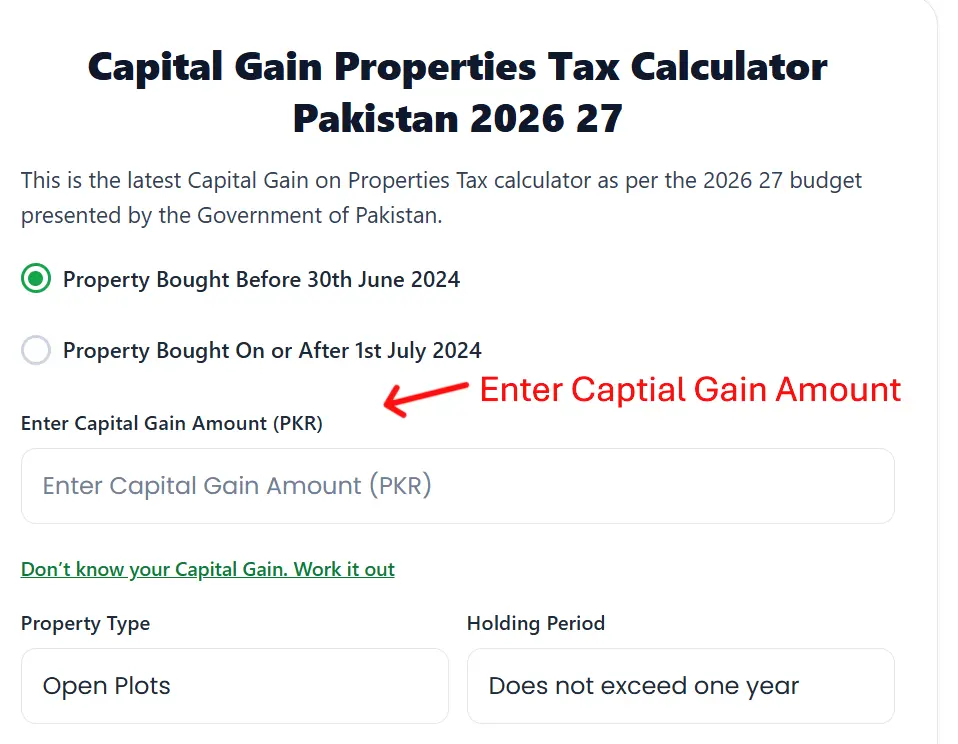
Determine your capital gain: If you already know your net capital gain amount, type it directly into the main field. If you don't know it, click "Don't know your Capital Gain. Work it out" to input your purchase price, sale price, and expenses to automatically calculate your gain.
Provide tax or property details: Depending on your timeframe selection, use the dropdown menus to select your specific Property Type and Holding Period (for older properties) or your ATL status and Legal Status (for newer properties).
Calculate your results: Click the main "Calculate Tax" button. The calculator will immediately reveal a detailed breakdown showing your net taxable gain, your specific tax rate percentage, and the final annual income tax amount owed.
Benefits of Using Our Calculator
Free of Cost
There's no charge to use it. Simply select the relevant fields, enter your capital gain amount, and hit calculate. The tool shows you the taxable amount immediately.
Real Estate Focus
Built with input from real estate and taxation experts, so property dealers and individual sellers don't need to consult a tax advisor just for a quick estimate.
Updated Information
The calculator reflects the latest figures from the Federal Budget 2026 27 and current FBR guidance, so you're never working off outdated rates.
Covers All Property Types
Whether you're dealing with files, open plots, constructed units, flats, or commercial buildings, the calculator is built to handle every common real estate transaction type.
Common Mistakes & How You Can Avoid Them
1. Declaring a Different Price Than the Actual One Some sellers understate the sale value to reduce their tax bill. This is risky: if the FBR catches the discrepancy, it can lead to heavy penalties and legal trouble.
2. Assuming Holding Period Benefits Still Apply Under the new regime (property acquired on or after July 1, 2024), there is no holding period benefit, not even for filers. Whether you sell the property in one year or hold it for twenty, the same 15% (filer) rate applies.
3. Misclassifying Purchase or Sale Dates Deliberately or mistakenly altering the purchase or sale date to claim a lower tax bracket is a common error that can trigger penalties if flagged during an FBR review.
Conclusion
Capital Gain Tax doesn't have to be confusing. Once you understand that it applies only to your profit, not your full sale price, and that your acquisition date and filer status decide which rules apply to you, the calculation becomes straightforward. Use our calculator to get an instant, accurate estimate before you finalize any property deal.